

Analysing Postcolonial Queer Knowledge Production in Dédé Oetomo’s GAYa NUSANTARA
Introduction – Pride, in Translation
In the early stages of the queer movement in Indonesia, Dédé Oetomo founded GAYa NUSANTARA in 1987,[1] an organisation that also published a magazine of the same name as part of the movement. In the first issue of GAYa NUSANTARA, Oetomo published the article “Homoseksualitas Di Barat Dan Di Indonesia”[2] (“Homosexuality in the West and in Indonesia”), which compares the histories of homosexuality in Western and Indonesian cultures from a psychological perspective, advocating that homosexuality is a universal phenomenon rather than an illness. Notably, this article draws on frameworks from Western academia to demonstrate the legitimacy of Indonesian homosexuality, while Oetomo himself was educated at Cornell University even as his Indonesian identity affords him an emic perspective. In other words, even though it demonstrates the existence of homosexuality before colonialism, the article still seeks legitimacy from a Western perspective. This raises a question: why does Oetomo, in 1987, need to simultaneously invoke the two contradictory discourses of Western science and Indonesian tradition in his struggle for the legitimacy of queer people? Furthermore, if this structural dilemma of postcolonial knowledge production cannot be escaped, what is produced in the “failure” of the attempt to escape it? Based on Boellstorff’s anthropological studies from The Gay Archipelago,[3] this essay argues that Oetomo’s article performs a “dubbing” not of identity categories but of the historical discourse of Western modernity itself, seeks to escape the Western narrative of homosexuality but paradoxically uses the Western framework to de-Westernise the Indonesian queer subject – and it is precisely within this paradox that a new, locally inhabitable subject position is opened up.
Theoretical Framework – The Grammar of Dubbing
Boellstorff coins the term “dubbing culture” to describe how homosexual Indonesians construct their queer subjectivity. Like a Western film dubbed into Indonesian, the overall effect appears incoherent – the “speech” and the “gesture” do not match. This incoherence arises from the juxtaposition of different elements, which creates the “seams” but does not prevent understanding.[4] Rather, it is this juxtaposition – which does not integrate the different elements – that creates a space belonging to neither cultural logic, allowing new understanding to arise. Boellstorff uses this metaphor to describe the relationship between Western queer culture and homosexual Indonesians: when they use the terms “gay” or “lesbi” – words that originate in the West – to dub their Indonesian identity, the seams remain, because the logic of Western discourse and that of Indonesian local circumstances are each independent and cannot be integrated.[5] Yet within the seam – a space for new meaning-making – queer Indonesians construct a dubbed, independent queer subjectivity.
Notably, whereas Boellstorff’s book mainly focuses on the dubbed identity and subjectivity, in Oetomo’s case the concept of “dubbing culture” reveals a juxtaposition of Western modernity discourse and local history at an academic, cognitive level. The essential difference is that this article embodies an integration – formally juxtaposed, but internally relying on Western discourse to justify local practices. In the context of postcolonial knowledge production, this integration is inevitable. In the first section of this essay, I will analyse how the historical landscape of the time gave rise to this integrating tendency. Nevertheless, this technical juxtaposition and the seams it creates are, from Boellstorff’s perspective, the fields where new theoretical discourses are generated.
Before introducing “dubbing culture”, Boellstorff questions the assumption that continuous history and identity can ground the authenticity of non-Western queerness, arguing that the desire for narrative continuity is itself a problem.[6] The core of this argument can be further demonstrated by Rao’s discussion of the temporality of queer postcoloniality. In his book Out of Time, Rao shows how the Western temporality marginalises postcolonial and queer “others” and excludes them from the chrononormativity, while this same standard is internalised by the “others” to marginalise themselves[7] (as when Oetomo uses Western modernity to explain Indonesian queerness). It is the imbalance between temporal-normativity and modernity-construction that creates the dilemma of postcolonial knowledge production. The second section will analyse this predicament through a dubbing perspective: in Oetomo’s case, I argue that his desire to take history as legitimacy is also the key to analysing the seam, which is the most direct manifestation of this dilemma.
Just as Boellstorff sees the seams as a site for constructing subjectivity, the cognitive seam in Oetomo’s article can also become the source of a new epistemological subjectivity. The value of the seam does not lie in entirely embracing either Western norms or local culture, rather, it lies in its revealing of the contradiction between the two cultures, its refusal to resolve that contradiction, and its embodiment of inclusiveness. Rao offers a way of reconsidering backwardness as a sign of progression – neither reverting to the past nor integrating into the mainstream future, but imagining, from a “backward” position, a future that does not assimilate into mainstream norms.[8] This perspective echoes Halberstam’s suggestion that failure can be a queer practice of resistance: the incoherent seam is itself a resistance to the mainstream, one that recognises that alternatives are already embedded within the dominant order.[9] Building on these insights, in the third section, I will explain how the seam embodies this value and becomes a field for postcolonial queer subjectivity.
Discretion and Nation: Conditions of the Dub
The publication of GAYa NUSANTARA – even if its circulation remained small in scale – was inseparable from the tacit tolerance of same-sex life afforded by the heteronormative social and political context of the time: the heteronormative society is not directly homophobic.[10] Yet this same context raises a paradox.
Consider the introduction to Oetomo’s article:
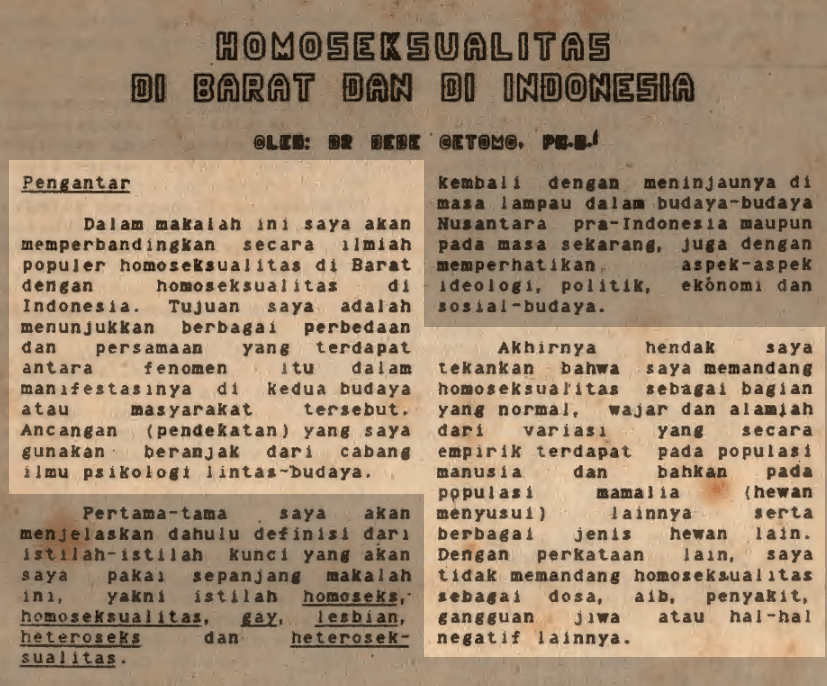
(In this paper, I will present a popular scientific comparison between homosexuality in the West and homosexuality in Indonesia. My aim is to demonstrate the various differences and similarities between this phenomenon as it is manifested in these two cultures or societies. The approach I adopt is based on the field of cross-cultural psychology. […] Finally, I wish to emphasise that I regard homosexuality as a normal, natural, and inherent part of the variation that exists empirically within the human population, as well as among other mammalian populations and various other animal species. In other words, I do not regard homosexuality as a sin, a disgrace, a disease, a mental disorder, or any other kind of negative phenomenon.) [11]
This statement of the article’s methodology and position unfolds in an academic register and claims nothing more than the legitimacy of homosexuality. This article was published in October 1987, during Suharto’s New Order. This heteronormative regulation was directed mainly at non-marital heterosexuality, since the state regarded the private sexual activity of unmarried heterosexual couples as a threat to the heterosexual-reproductive family principle that was foundational to national identity and society.[12] As long as men who desire same-sex relations remained discreet and respected certain social conventions (such as forming familial bonds), such desire could be pursued as a private practice.[13] Therefore, queer existence was tacitly permitted if they did not publicly challenge the norms. This also explains why GAYa NUSANTARA could exist: it did not take human rights discourse as its primary agenda but instead worked to dispel homophobic stereotypes and the assumption that homosexual identity originated in the West, thereby affirming queer identity and self-identification.[14] Within Oetomo’s article, its packaging in academic and medical language further reinforces this depoliticising effect, and his claims make not direct challenge to the larger political structure.
Furthermore, if we turn to the nationalist dimension of the regime itself, its central purpose lay in building a unified national identity. Suharto sought to consolidate his power by ensuring that everyone saw themselves first and foremost as Indonesian,[15] and this imperative entailed a resistance to foreign cultural influence. Oetomo points out in the conclusion:
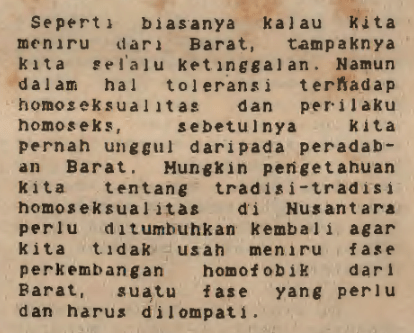
(As usual, when we imitate the West, we always seem to lag behind. However, in terms of tolerance for homosexuality and homosexual behavior, we were actually once ahead of Western civilisation. Perhaps our knowledge of homosexual traditions in the archipelago needs to be redeveloped so that we don’t have to imitate the homophobic developmental phase of the West, a phase that needs to be and must be skipped.)[16].
The core of his article lies in strengthening the historical legitimacy of local homosexuality through a comparison between the West and Indonesia, and in resisting the Western cognitive framework – a move that aligns precisely with the demands of nationalism. Here a dual-demand becomes visible: the same regime that pushed Oetomo toward a depoliticised, Western academic idiom also required him to resist the West by reclaiming local history. The paradox is best demonstrated in the conclusion: the terms “ahead” and “behind” already belong to the timeline of Western modernity. In other words, his means of resistance is precisely the object he resists. One might assume that, since Oetomo was trained at Cornell University, his reliance on Western epistemology and methodology to ground his argument was simply natural. However, this is not a matter of personal preference. The emergence of this paradox is not accidental but a concrete historical manifestation of a systemic structural predicament: in seeking to resist the narrative of Western modernity, postcolonial knowledge production is compelled to rely on the discursive tools that this modernity provides. It is precisely this predicament that gives rise to the integrating tendency running through Oetomo’s article.
The Seam as Failure
Read through Boellstorff’s “dubbing culture”, Oetomo’s article can be seen as a dub performed at the level of academic discourse: he dubs the image of Western modernity with an Indonesian historical voice. Yet this dub does not hold the two cultures in the open juxtaposition that defines dubbing culture; instead, beneath a juxtaposed surface, their underlying logics converge in a single direction – Indonesian practice is rendered legible only through a Western framework. This convergence is not an equal negotiation between the two cultures but the result of a postcolonial epistemology already permeated by the West. Therefore, the seam produced by this formal juxtaposition does more than register a difference of cultural logic: it exposes the profound imprint of colonialism on postcolonial knowledge – beneath the posture of resistance, the starting point of knowing has already capitulated. Drawing on Fabian, Rao describes the characteristic of the imperialist temporal violence, namely the “denial of coevalness” – the refusal to grant that all human societies inhabit the same age. Postcolonial societies are instead positioned as “primitive”, as formations that must be “civilised” and “developed” before they can arrive at a modernity the West already occupies in some distant future.[17] It is this temporal marginalisation of the postcolonial and the queer that lays the ground on which their epistemology rests.
Return to Oetomo’s claim in the conclusion that Indonesia was once more advanced than the West on questions of homosexuality and homophobia. Built on the article’s reconstruction of an Indonesian homosexual past, this claim places local tradition onto the West’s timeline of progress, and that epistemological misalignment is precisely the seam of the dub. While Boellstorff’s dubbing builds a subjectivity, Oetomo’s builds a whole way of knowing: the dub operates at the most basic level of how local homosexuality is to be understood in the first place. As Wijaya describes it, “the process of connecting modern gay identity and localised homosexual and/or transgender practices to create a valid claim to Indonesian-ness has generated a nostalgic fantasy that Indonesia in the past was actually ‘tolerant’ of homosexuality.”[18] Beyond functioning as a way of thinking, this nostalgia is also an exercise of the activist agency: the activists can (and have to) identify, select, rely on, assemble, and deploy particular pieces of available evidence from local practice in order to pursue political ends.[19] In other words, the nostalgia is a strategic instrument that the activists mobilise within a predicament they did not choose. Through it, Oetomo establishes an ideological account of local homosexuality and uses that account to enhance the legitimacy of its indigeneity.
However, the epistemic ground of this nostalgia is precisely what this essay questions: the nostalgia, or the seam, is itself the most direct manifestation of the predicament of postcolonial knowledge production. As Wijaya points out the limits, this strategy and agency “are always structured within existing socio-material surroundings,” – they emerge only through entanglements with knowledge from “outside” – entanglements that dissolve any distinction between global and local, Western and Indonesian, past and present.[20] More specifically, the limit is that the strategy cannot escape the Western temporal system that serves as its measure. The seam, then, is not a flaw in Oetomo’s legitimising practice, but a structural dilemma. The object he dubs – Western modernity – fixes the starting point of his knowing in temporal violence rather than in local practice, and the act of dubbing is itself shaped by Western knowledge. In short, the knowledge that grows from this seam has had its direction settled in advance by the convergence beneath it.
The Seam as Field
The first two sections of this essay analyse the epistemological predicament that Oetomo’s dubbing reveals, and have treated the seam as a failure. Yet just as Boellstorff sees the seam as the field in which a distinctive queer Indonesian subjectivity is constructed, the present extension of his concept to discourse and epistemology lets the same predicament be read as a space in which a new way of knowing might emerge. If the tension between West and local in Oetomo’s article leads to the conclusion that his attempt to escape the Western framework has failed, then, regarding the issue of decolonisation, the more productive move is not to ask how that failure might be undone, but to ask what the failure itself means and what value it carries.
To begin with, as Wijaya argues, this nostalgia is itself a product of contact with external knowledge, one that dissolves the boundaries between diverse heterogeneous elements.[21] From the perspective that measures it against the West, this entanglement is its limitation – the mark of its “failure”. However, seen from its own position, the same entanglement means something else: the nostalgia belongs to neither cultural logic alone. The significance is not that it escapes Western influence, but that the position it occupies cannot be claimed by either the global or the local. The contradiction is only apparent – “dependence” and “belonging to neither” are the same seam described from two different starting points. This independence allows its negative features – “backward”, “limited” – to be reclaimed as the starting point of a way of knowing. Under this interpretation, its “failure” features then can be reconsidered in a way that deviates from the existing paradigm. Rao examines “backwardness” through comparing Indian trans people and Dalits within the caste system: from an external, objective perspective, marginalised groups are fixed as others in a past moment of time, and to eliminate their backwardness is to make them evolve towards the mainstream; but from an internal, subjective perspective, backwardness – as the position from which these groups begin – already contains the potential to transform society in a direction distinct from the one set by the dominant order.[22] What is decisive, then, is this divergence of standpoint – whether Oetomo’s dubbing is approached as an object measured from outside or as a subject position occupied from inside. Halberstam locates the value of “failure” from such a subjective perspective: according to him, “queer studies offer us one method for imagining, not some fantasy of an elsewhere, but existing alternatives to hegemonic systems.”[23] In Oetomo’s case, the value of his “failure to escape the Western framework” lies not in having tested a path that turns out to be impassable. Rather, it lies in what that impossibility teaches: that decolonising knowledge production cannot mean stepping outside the West into some untouched elsewhere, but must be carried out from within the entanglement itself. More precisely, the question becomes what distinctive way of knowing can arise from the postcolonial position for queer Indonesians to understand themselves. Returning to the dubbing culture, Boellstorff argues that dubbing neither seeks nor rejects the authentic but lies alongside it, opening up new possibilities for reconfiguration – instead of producing a coherent or transparent text or subject, the juxtaposition lets the seam remain, and it is this seam that becomes a sphere in which new subjectivity can arise.[24] This non-convergence is what constitutes the “archipelagic” subject position Boellstorff describes – unlike a Western subjectivity that demands coherence and continuity across all domains of life, Indonesian subjectivity is “a more ethnographically and theoretically precise specification of multiplicity than the rather obfuscating term ‘fluidity.’”[25] Extended to Oetomo’s epistemological dubbing, the seam between the two cultural logics constructs a distinctive queer epistemic standpoint. Consider how he draws on Western discourse in order to recover an indigenous understanding of homosexuality: viewed from his own subject position, his account of local practice borrows Western conceptual elements without fully adopting the Western developmental path. This is an archipelagic epistemology and a distinctive orientation for the development of queer culture in Indonesia. What makes his dubbing “fail”, ultimately, is precisely what enables it to serve as a domain of postcolonial queer subjectivity. Once the perspective shifts from the Western standard that measures it back to its own subject position, the seam ceases to be a mark of failed escape and becomes the starting point of an alternative path of knowing.
Conclusion – The Positionality We Cannot Escape
Throughout the analysis, we have witnessed a shift in Oetomo’s cognition of Indonesian queerness – from the Western definition of homosexuality to local historical tradition, as well as a shift in the epistemological standpoint from which we perceive that cognitive shift – the external object position and the internal subject position. Through the perspective of dubbing culture, Oetomo’s practice in 1987 should be seen not only as a manifestation of postcolonial knowledge production, but also as a productive “failure” that resists the dominant Western normativity. In his book, Boellstorff uses the term “cultural logics” more often than “discourse”, since he mainly focuses on unintentional cultural production.[26] In contrast, this essay applies “dubbing” to a case of intentional, institutional production: an intellectual elite deliberately dubbing the Western modernity that institutional power produces. Through this case, we can see that the dub and the seam still exist even when the practice and self-construction are intentional – further demonstrating the reach of Boellstorff’s framework for analysing the “archipelagic” Indonesian queer subject.
However, it is critical to realise that, although this paper draws on seemingly “de-Westernised” theories, these theories are themselves produced within Western academia. The “alternative” this paper invokes, within the context of Western cultural studies, still possesses a subtle division between a default and its other. This limitation, like Oetomo’s, is also an epistemological predicament that this paper itself faces. Back to the scene of Utrecht Pride: when we witness a “typical” pride and imagine a different way of being proud, is the imagination itself not a Westernised paradigm rooted in our minds? All in all, beyond analysing a historical case, this paper also aims to offer a reminder – to constantly reflect on the positionality that we cannot escape.
[1] Hendri Yulius Wijaya, Intimate Assemblages: The Politics of Queer Identities and Sexualities in Indonesia (Singapore: Palgrave Macmillan, 2020): 70-71, https://search.ebscohost.com/login.aspx?direct=true&scope=site&db=nlebk&db=nlabk&AN=2373968.
[2] Dédé Oetomo, “Homoseksualitas di Barat dan di Indonesia,” GAYa NUSANTARA, no. 1 (November 1987): 9–20, https://qiarchive.org/id/berkas/gaya-nusantara-1-2/.
[3] Tom Boellstorff, The Gay Archipelago: Sexuality and Nation in Indonesia (Princeton: Princeton University Press, 2005), https://doi.org/10.1515/9781400844050.
[4] Boellstorff, The Gay Archipelago, 82.
[5] Boellstorff, The Gay Archipelago, 82.
[7] Rahul Rao, Out of Time: The Queer Politics of Postcoloniality (New York: Oxford University Press, 2020), https://search.ebscohost.com/login.aspx?direct=true&scope=site&db=nlebk&db=nlabk&AN=2383358.
[9] Jack Halberstam, The Queer Art of Failure, (Durham, NC: Duke University Press, 2011), https://doi.org/10.1215/9780822394358.
[10] Jón Ingvar Kjaran and Mohammad Naeimi, Queer Social Movements and Activism in Indonesia and Malaysia (Cham, Switzerland: Palgrave Macmillan, 2022), https://doi.org/10.1007/978-3-031-15809-4.
[11] Oetomo, “Homoseksualitas di Barat dan di Indonesia,” 9.
[12] Wijaya, Intimate Assemblages, 51.
[13] Kjaran and Naeimi, Queer Social Movements, 86.
[14] Ibid., 87.
[15] Wijaya, Intimate Assemblages, 55.
[16] Oetomo, “Homoseksualitas di Barat dan di Indonesia,” 20.
[18] Wijaya, Intimate Assemblages, 43.
[21] Wijaya, Intimate Assemblages, 69.
[22] Rao, Out of Time, 174-212.
[23] Halberstam, The Queer Art of Failure, 89.
[24] Boellstorff, The Gay Archipelago, 219.
[25] Ibid., 202-205.
[26] Boellstorff, The Gay Archipelago, 7.


Leave a Reply