
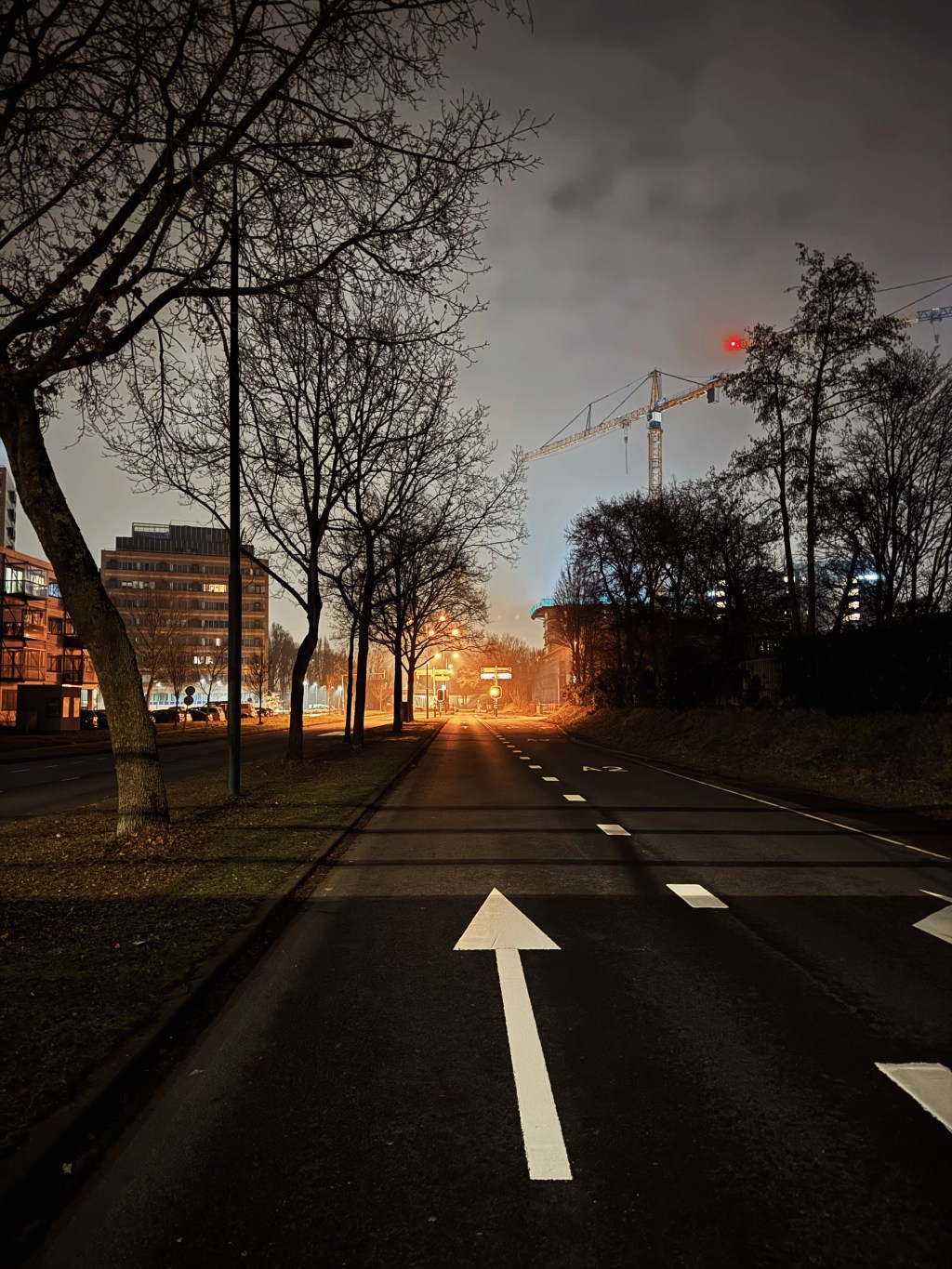
I live in Maarssenbroek, on the street of Het Kwadrant, which seems like a community from the future, but is currently still full of construction sites, dust, and uneven pavements that hurt my ankles. In this chaotic neighbourhood, residents misbehave and throw trash around the bins rather than putting it inside properly. Maybe because the bins here require a special card to swipe open, and people always forget to bring it – around the bins there are always trash bags piled up like a mountain, inviting a lot of fat rats to live here happily. People complain about this in WhatsApp groups apparently, while for some of the Chinese residents, the chaos in WhatsApp is not enough and they started another witch hunt in the WeChat group.
One day, the group admin sent a blurry video of an Asian person throwing trash outside, filmed from a window, publicly telling this person to stop. Even though he said it in a very gentle way, I still felt uncomfortable about the secretly-shot footage being sent into a public group. Then a debate burst out about the trash, the video, privacy, the law. I was a bystander watching their fight like a drama, when I suddenly noticed that in their argument there was an underlying logic they implied time and time again – don’t misbehave and make other residents feel bad about Chinese people.
Everything seemed so absurd to me after I realised this logic — though I have to admit I sometimes have the same thought myself. It is an ingrained cultural habit that unconsciously affects our behaviour. Why do we elevate individual behaviour to the level of collective image? I don’t know if this habit exists in other cultures, but I found it absurd even in primary school, when teachers told us that one student’s misbehaviour breaks the entire class’s honour – as if a criminal sitting in the same room as elites makes the elites as disgusting as the rats around the trash bin. Being abroad brought me new feelings about this collective myth.
Undoubtedly, the mutual inspection within the Chinese community is predominantly rooted in our culture. What bothers me is that in the context of being abroad, this model-immigrant regulation constantly reminds me that I am permanently an outsider, a guest. The mechanism itself is not new. In China, we grew up with it: a single student’s flaw blackens the entire class’s honour. However, the audience for that honour was internal – other teachers, the school, the institution. Here in the Netherlands, the imagined observer is now European. “Do not misbehave and make other residents feel bad about Chinese” – whose eyes is this sentence written for?
I was watching this debate unfold as a spectator. But spectatorship is a luxury I don’t always have. Most of the time, the discipline doesn’t need a WeChat group to operate. It runs quietly, within me, in spaces where no compatriot is even watching. Or worse – in spaces where I am the one watching.
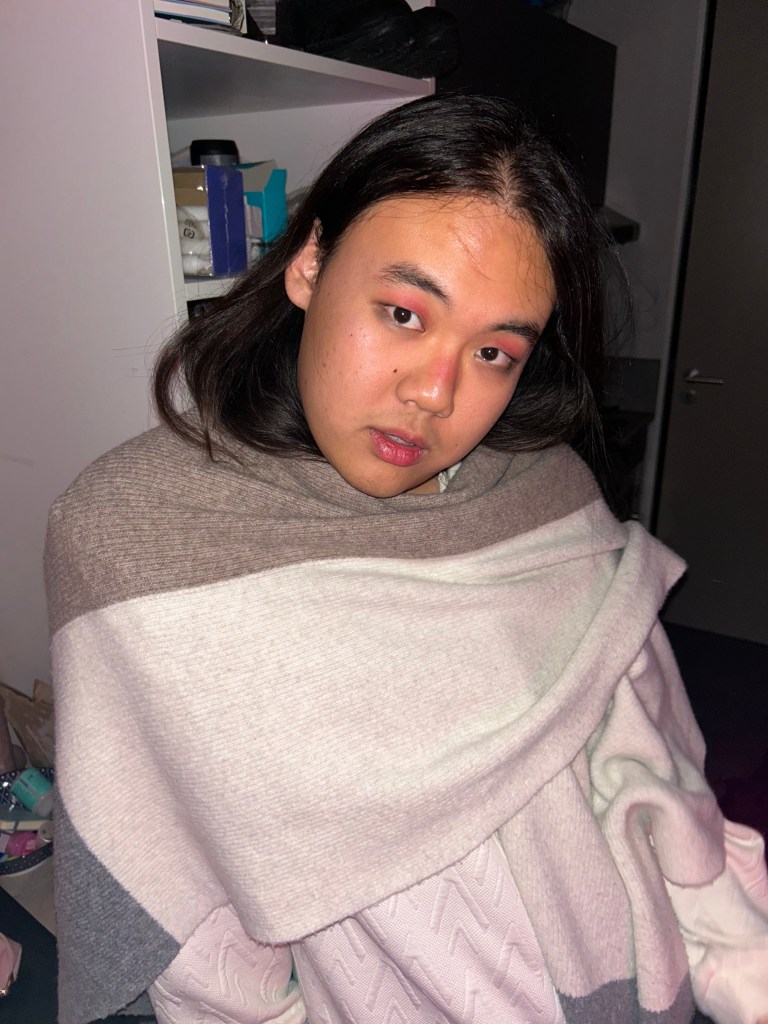
Last October was the first time I wore makeup in public. I was at my friend’s place, waiting for others to arrive for a weekend drink. When my friend started doing her makeup, she suddenly asked if I wanted some too. The answer was obviously yes — I’d always felt I was being too masculine for a queer person. We had a great night: rough but vibe-changing makeup, great drinks, an enthusiastic hang-out in the cold cloudy autumn air. Later, I took the bus home and walked through the silent suburban neighbourhood. Two guys who also lived in my building were walking behind me, and then I realised they were Chinese. I felt awkward immediately — being openly queer in front of Chinese men always carries risk, because you never know if they’re open-minded or not.
The strange thing is, I never feel uncomfortable being queer in front of Western people, regardless of their gender, age, ethnicity, or appearance. I just naturally act like myself, as if they never pay attention to me — and usually they really don’t care. But in front of my own people — a group with whom I should feel most comfortable — I become nervous about everything.
So I made a decision I now look back on as stupid: I called my friend and spoke in English, pretending to be a Chinese-American — someone who merely has an Asian face but has no cultural connection to China. Those were the most awkward ten minutes I’ve ever experienced, standing in the same lift as them, speaking English and trying my best to hide even the smallest trace of a Chinese accent. Cutting myself off from being Chinese to escape the evaluation of my compatriots.
I still feel bad about that. I’ve always “convinced” myself I’m proud to be Chinese — but as I use the quote marks for the word “convinced”,” I wonder: am I really? If so, why did I unconsciously choose to pretend I wasn’t?
“Performance” — this is the only word that came to mind when I thought about it afterwards. I felt like I was performing different identities all the time: a proud Chinese who doesn’t want to be whitewashed and lose his roots, or a fake “Chinese-American” who just wants to escape the insecurity. This word reminds me of Judith Butler’s concept of “performativity.” Rather than being “fundamentally Chinese but performing on the stage of life,” I would say even the identity of being Chinese is performed — the only difference is the level of proficiency. Twenty-two years practising “Chinese,” two years practising “overseas Chinese” since I came to the Netherlands. In that lift, I wasn’t wearing a mask to hide — I was choosing the most advantageous option in the moment, between two equally real and equally manipulated identity scripts.
“Performativity must be understood not as a singular or deliberate “act,” but, rather, as the reiterative and citational practice by which discourse produces the effects that it names.”[1]
This act of selection already reveals something: I have options. After two years of living abroad — which is also two years of practising performance — the identity of a fake overseas Chinese is ready to be deployed at any moment. Those seemingly improvised ten minutes were actually a withdrawal of performance capital accumulated over two years. But what drove me to start training this second script in the first place?
Professor D. Westermann, in The African Today, says that the Negroes’ inferiority complex is particularly intensified among the most educated, who must struggle with it unceasingly. Their way of doing so, he adds, is frequently naïve: “The wearing of European clothes, whether rags or the most up-to-date style; using European furniture and European forms of social intercourse; adorning the Native language with European expressions; using bombastic phrases in speaking or writing a European language; all these contribute to a feeling of equality with the European and his achievements.”[2]
There is the newcomer, then. He no longer understands the dialect, he talks about the Opera, which he may never have seen except from a distance, but above all he adopts a critical attitude toward his compatriots. Confronted with the most trivial occurrence, he becomes an oracle. He is the one who knows.[3]
Last September, I was smoking outside waiting for my class to begin, in front of Janskerkhof. I saw a short Chinese student wandering around, frequently checking her phone and looking around. I guessed she might be a freshman who didn’t know where the classroom was. She was very short, dressed like the average Chinese person I could meet any day in China — straight bangs covering most of her face, a giant schoolbag, humpback, the entire person gave me a typical, cowardly, introverted “Chinese vibe.” It was possibly the sleepy early start and grey weather that made me irritable, I somehow felt angry at her. I still remember the guilty feeling I had:
“Why can’t you be graceful and poised, confident and composed, calm and unhurried, natural and dignified — or at least “normal” like everyone else in this country? There are so many Chinese people abroad working hard to change everyone’s stereotypical image of us. Why are you still acting like this, deepening the misunderstanding and erasing other people’s efforts?”
After this, an ugly sense of superiority crept in. “Compared to her, I AM SUCH A MODEL!” I’m relaxed, I’m distinctive — even in my first year when I couldn’t find the room, I acted calm and composed, pacing around campus as if enjoying a garden. I was worried inside, but my appearance stayed natural, like someone fully integrated. I’m not a stereotypical Chinese person for white people — I speak English a lot, I hang out with all kinds of people, cooking greasy Chinese food every day in my studio is not the whole world of my life abroad. I’m tall enough to live comfortably in the Netherlands. I don’t have to complain about the giant bicycles, the tall urinals, the mirrors that show me their foreheads only. “I AM SO GREAT!”
Sounds really terrible, doesn’t it? I hate these thoughts too. Even though I would never say any of this aloud or hurt anyone, I still feel bad for having them so often.
Reading Fanon, I keep finding myself in sentences that weren’t written about me.
In any group of young men in the Antilles, the one who expresses himself well, who has mastered the language, is inordinately feared; keep an eye on that one, he is almost white. In France one says, “He talks like a book.” In Martinique, “He talks like a white man.” The Negro arriving in France will react against the myth of the R-eating man from Martinique. He will become aware of it, and he will really go to war against it. He will practice not only rolling his R but embroidering it. Furtively observing the slightest reactions of others, listening to his own speech, suspicious of his own tongue – a wretchedly lazy organ – he will lock himself into his room and read aloud for hours – desperately determined to learn diction.[4]
That girl, that innocent Chinese girl, that poor passer-by who was hated so much without even realising it, she didn’t do anything wrong. She was just confused, as every freshman is. After months of feeling guilty about the thoughts that came to me then, and that come to me still, I finally realised what made me angry was not anything she did wrong, but how much she reminded me of the effort I had put into becoming nothing like her. I tried to suppress these thoughts; I tried to become more Zen, less sarcastic — like polite Europeans are, at least on the surface. And then I noticed what I had done: reached for another performance, this time the model I was citing was “the tolerant European.” Had I escaped the script, or merely switched to a more sophisticated version of it?
Recently an acquaintance told me a story. A Martinique Negro landed at Le Havre and went into a bar. With the utmost self-confidence he called, ‘Waiter! Bing me a beeya.’ Here is a genuine intoxication. Resolved not to fit the myth of the nigger-who-eats his-R’s, he had acquired a fine supply of them but allocated it badly.[5]
[1] Judith Butler, Bodies That Matter: On the Discursive Limits of “Sex” (Abingdon, Oxon: Routledge, 1993).
[2] Frantz Fanon, Black Skin, White Masks (London: Paladin, 1970), 25.
[3] Ibid., 24.
[4] Ibid., 20-21.
[5] Ibid., 21.


Leave a Reply