
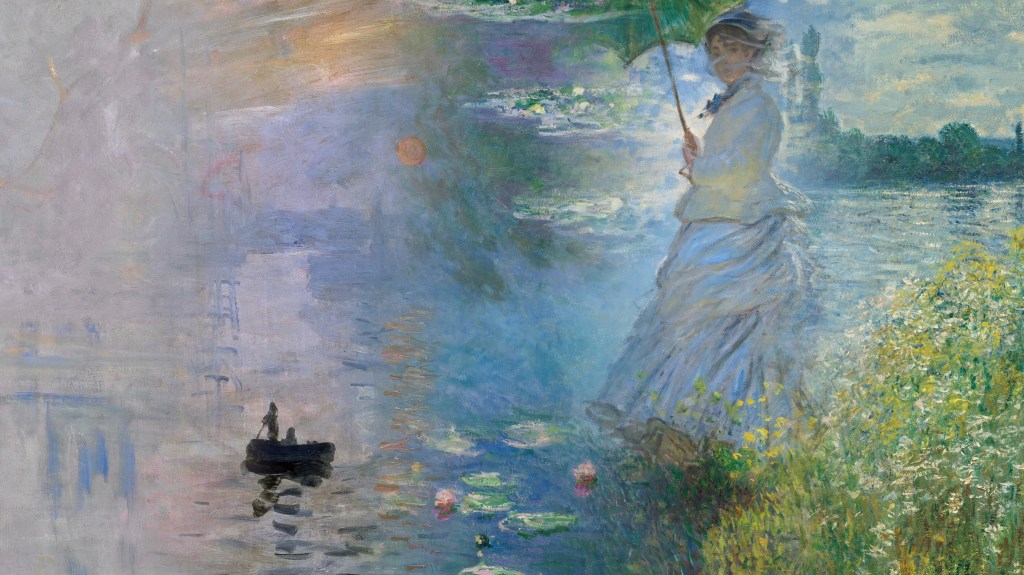
Rethinking Cross-Boundary Aesthetic Resonance through Impressionist Arts
I can’t tell if I like this essay or not—the brainstorming was fun, I like Impressionism a lot, and I really think this topic and case are insightful to discuss. I also wanted to try the argument structure of a “bouquet,” or cómo se dice a “Plan Thématique” in French. However, due to the strict deadline, I failed to perfectly present this piece, at least by my standards. I wish I had more time to polish it, but by the time I submitted it, I had lost all my patience for this topic, you might notice my frustration throughout this sloppy writing and structuring… Currently, the only wish of mine is to pass this course, while deep inside I still hope this article is valuable to some extent :’)
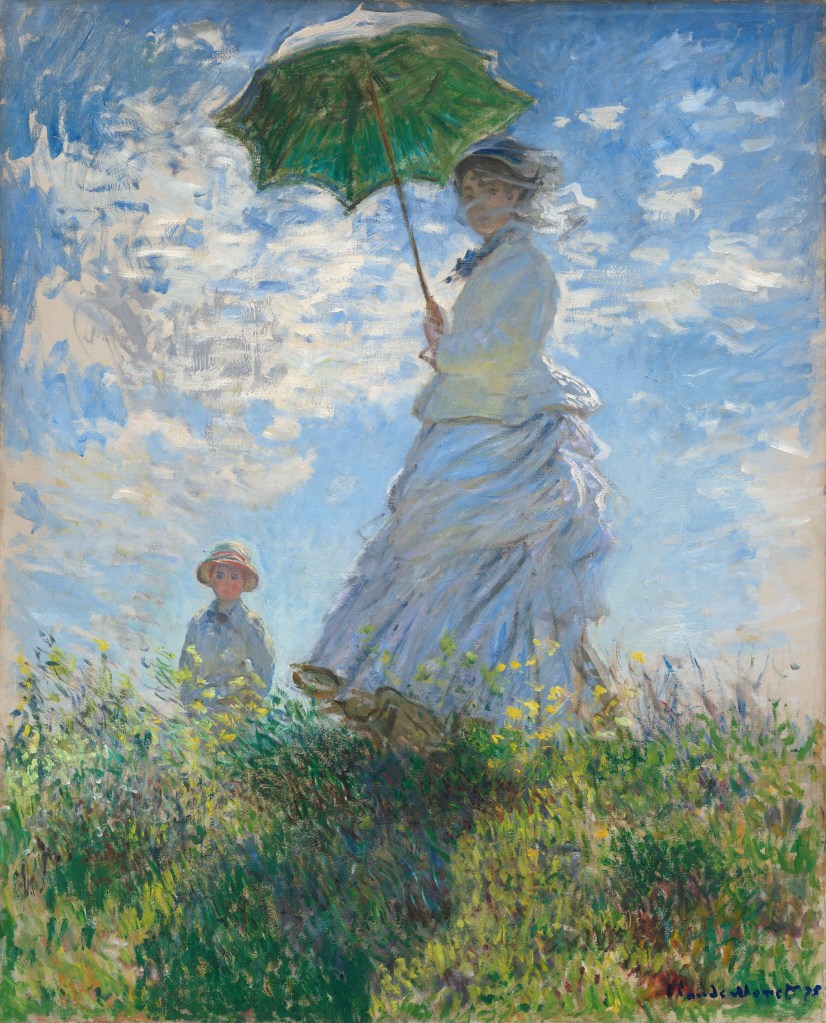
Before I knew the concept of Impressionism, I had already encountered many paintings by Claude Monet and musical pieces by Claude Debussy. One of my favourite pieces by Debussy is La fille aux cheveux de lin. What is interesting is that when I listen to it, I do not conjure up an image of a girl with flaxen hair, despite the title explicitly suggesting it. Instead, it is always Madame Monet who appears vividly before me: she is just standing there, standing in the late spring garden with a backward glance. A warm wind blows through me, bringing me colourful views of the world, while the music suspends the whole scene in an exotic, peaceful state of mind.
This experiential cross-media conflation puzzled me: why would a musical piece remind me of an oil painting, which is also an Impressionist artwork as Debussy’s piece does. Moreover, as someone whose artistic sensibilities are deeply shaped by Chinese aesthetics, I found myself in a particular position: Western art often feels culturally distant, but Impressionists evoke an unexpected sense of resonance – not merely intellectual appreciation, but genuine affective engagement. The mystery is, what creates this cross-cultural resemblance? Why do Monet’s paintings and Debussy’s music, which are products of late 19th-century France, generate atmospheres that somehow feel familiar to a viewer trained in Chinese aesthetics?
These experiences raise deeper questions: what kind of aesthetic operation allows a musical piece and a painting to generate the same affective atmosphere without an apparent narrative connection? Furthermore, what underlying mechanism enables Impressionist artworks to transcend cultural boundaries, creating resonance even for viewers outside their Western context? Traditionally, we can analyse this phenomenon through representation, cultural contexts, formal analysis – focus on how Monet capture lights, how Debussy employs harmony, how medium boundaries are blurred, tracing influence or shared origins across artistic forms. My experience, however, suggests something that transcends these boundaries.
This blog will discuss this aesthetic phenomenon in two dimensions. Starting with continuing the discussion of cross-media affective experience I mentioned above, based on Gernot Böhme’s atmosphere theory[1], I will discuss how Monet and Debussy’s Impressionist works create an atmospheric field that invites spectators’ participatory engagement. Then, regarding the cross-cultural comparison, I will introduce a Chinese film theory – “kong qi” theory[2] – and relevant aesthetic concepts to compare Impressionist painting and Chinese ink wash painting, exploring how they obtain similarity in aesthetic operational logic. These two dimensions seem divergent, while they collectively aim to interrogate whether a shared aesthetic mechanism exists beneath the boundaries of media, culture, and theory. By doing so, this blog seeks to discuss the necessity of a broader interdisciplinary perspective within Media and Cultural Studies.

We Imagine, Transcending the Medium
The Water Lilies – Green Reflections, one of the most famous works by Monet. Personally, this painting reminds me of Debussy’s Arabesque No.1 by Debussy, and vice versa. Yet this cross-media association remains highly personal – there is no definitive explanation for why one evokes the other. Rather than sharing the same media form or having mutual reference, it is the abstract aesthetic concept of “atmosphere” that bridges my perception of these two works. Böhme theorises atmosphere as the common reality of the perceiver and the perceived, in the context of media, this in-between synthetic appears only through the spectator’s active engagement with the work.[3] It is precisely this interactive nature of atmosphere that allows subjective perceptions to arise and resonate across different art forms.
Impressionist artworks exemplify the concept of atmosphere because they are non-narrative, evocative, and experiential rather than representational. These characteristics maximise the openness for spectators to engage, creating the condition for atmosphere to emerge. Crucially, the atmosphere is not “given” by the artwork, but co-created through the viewer’s bodily presence.
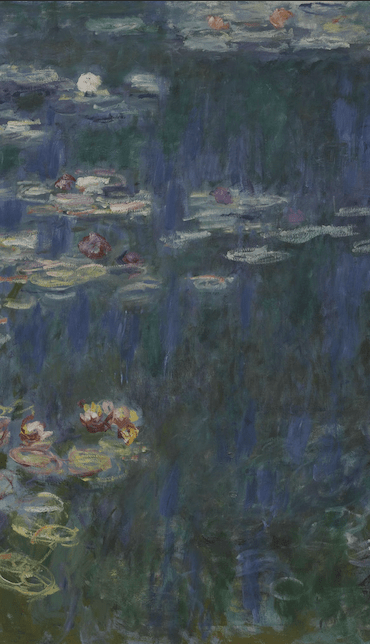
In The Water Lilies – Green Reflections, Monet captures the subtle light-changes of a water lily pond from dusk to dawn. He erases the horizon and frame’s edges, causing all of the elements – water, air, sky, earth – to intertwine in a composition without perspective.[4] There is no dominant subject: the water lilies are blurred and lack detail. Monet merely uses subtle colours and loose brushstrokes to suggest their presence rather than represent them precisely. This refusal of definition creates an open field where the spectator’s perception is required to complete the scene. Without a horizon or focalisation, viewers cannot settle their attention but must move across the canvas. The large scale and enveloping composition create a sensation of being immersed within the pond rather than observing it from a distance.
Debussy’s Arabesque No.1 operates through a remarkably similar participatory logic, despite the difference in medium. This piece opens with triplet figures outlining arpeggiated chords, creating a wave-like undulating line, while harmonically producing a sense of tonal ambiguity; like Monet’s scattered water lilies, there is no single focal point, which may be musically understood as a lack of clear distinction between melody and harmony.[5] The listener cannot comprehend a fixed “subject” but must drift through the piece’s shimmering textures.
Both of these works prepare for atmosphere through incompletion, in both cases, the spectator is invited to remain in a suspended state rather than seek resolution. But this observation only describes what these works do, it does not yet explain why such incompletion enables cross-media association. The answer lies in a deeper shift in how these works operate aesthetically. Böhme distinguishes between a work as “sign” (pointing to external meaning) and as “presence” (making something perceptible through its own existence). He suggests treating paintings as “the represented is present in and through the painting” rather than as a sign conveying “a meaning which could only be thought.”[6] From the perspective of atmosphere, this distinction is crucial: artworks can bypass representation and act directly on the viewer’s bodily perception. Monet’s water lilies do not represent a pond or flowers, instead, they present the visual experience of watching water lilies as an immediate, bodily encounter. Similarly, Debussy’s piece does not signify the arabesque or “water” through programmatic imitation, but makes fluidity present through harmonic drift and rhythmic undulation. It is this mode of presence that creates atmosphere. Therefore, Impressionist artworks’ capacity to generate cross-media resonance does not rely on representational similarity, but on their shared invitation to inhabit an atmospheric state – a state constituted through presence rather than signification.
We Feel, Bypassing the Cultural Boundary
If cross-media resonance is possible, what explains cross-cultural resonance that a product of 19th-century France evokes familiarity in a viewer trained in Chinese aesthetics? A Chinese theory provides a lens to examine this puzzle. The “Kong qi” theory (“空气”说) emerges from the Chinese philosophical and artistic spirit of “kong view” (empty) and “qi view” (air). The term “kong”(empty) corresponds to the terms “illusory and unreal”,[7] and “qi” signifies fluidity, vitality, and underlying unity of all things. “Kong”, as the essence of emptiness and stillness, serves as the origin where everything rises from; then, these emergent phenomena flow breathe, and manifest as “qi” – vital energy that condenses to create the Chinese aesthetic spirit of “kongqi” (atmosphere). Rather than offering a fixed definition, Chinese scholars tend to approach “kongqi” as an ineffable concept – one that integrates philosophy, aesthetics, and methodology into an experiential whole. Therefore, it can only be fully comprehended through engagement with specific artwork, feel and perceive its presence rather than merely analyse it intellectually.
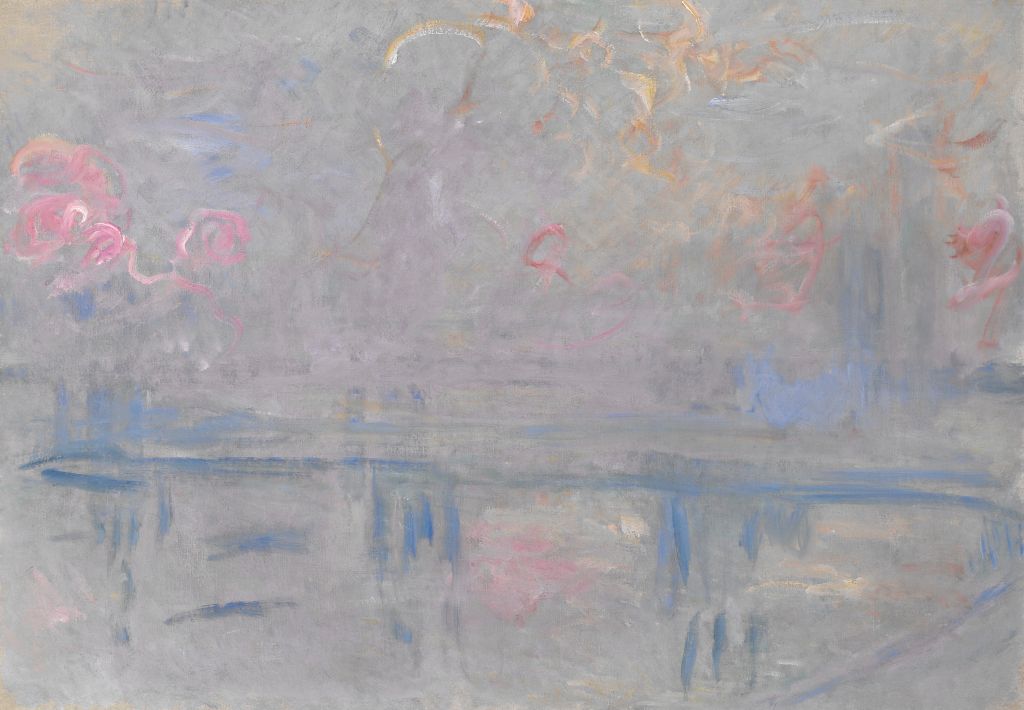
While Böhme’s atmosphere theory focuses on the co-creative role of the viewer’s perception, “kongqi” theory emphasises that atmosphere is inherent to the artwork itself, infused by the artist and existing independently of any particular viewer’s engagement. Nevertheless, “kongqi” should not be conflated with a fixed meaning. Although the artwork possesses its own atmospheric character, the viewer retains interpretive agency – different viewers may resonate with the same “kongqi” in diverse ways, perceiving varying depths and nuances within a shared atmospheric field.[8] If we reconsider Monet’s painting from the perspective of “kongqi”, the analytical focus needs a shift: rather than examining how the artwork engages the viewer’s bodily sensation, we need to concentrate on how the painting’s intrinsic spirit and vital energy already constitute a complete atmospheric world. In Monet’s Charing Cross Bridge (ca.1900), the aesthetic of indistinctness is already embedded within the work’s fabric. The bridge itself dissolves into barely recognisable blue brushstrokes, its architectural details obscured by fog. Grey tones dominate the canvas, blurring boundaries between sky, water, and mist, creating not a legible scene but an atmospheric series. From a Chinese hermeneutic perspective, this visual treatment exemplifies the aesthetic principle of “kong”, more precisely, the technique of liubai (留白, leaving blank), which does not merely signify absence but rather creates perceptual blanks through which “qi” can circulate. “Qi” emerges from this emptiness – the sense of incompletion and obscurity that permeates the canvas – and condenses into the “kongqi” of this painting. What’s more, the painting’s “kongqi” does not prescribe a singular affective response. It established an atmospheric tone within which viewers retain interpretive freedom.
The misty bridge is erased in the loudly London, for me, I recall an idiom “雾里看花” (look at flower in the fog), which is used to describe cannot see things clearly. Living in an obscure world, we cannot even clearly see an enormous bridge before us, then what can be trusted or doubted?
Back to the questions I raised in the introduction, “kongqi” theory provides an answer for this cross-cultural resonance with Monet’s artwork. “Kongqi” theory reveals a crucial mechanism of perceiving aesthetics: it suggests an operation of “tonghua” (同化, assimilation).[9][i] The artwork’s “kongqi” actively draws viewers into itself, erasing boundaries between observer and observed. When diverse viewers encounter Monet’s painting, they are not merely interpreting through their respective cultural lenses. Rather, they are all being assimilated into the same atmospheric space – preceding cultural interpretation and drawing viewers in bodily and affectively. This operation enables the cross-cultural resonance: regardless of cultural background, viewers who encounter the work find themselves sharing the same atmosphere.
We Breath, in the Same Air
What I have been exploring is a fundamental aesthetic operation that transcends boundaries of media, culture, and theoretical framework. I would call this mechanism “affective openness”: a deliberate refusal of closure that creates atmospheric fields inviting participatory “floating” rather than utilitarian resolution.
Affective openness operates through three interrelated gestures: [1] Incompletion. Whether Monet’s visual blurriness, Debussy’s harmonic suspension, or Chinese “liubai”, these works withhold complete sensory information – not as a deficiency, but as an invitation. They create perceptual blanks that cannot be filled through interpretation, but can only be “floated” within. [2] Refusal of the directive affects. They do not tell viewers what to feel. Monet’s fog does not prescribe “melancholy” or “serenity”, but establishes an atmospheric tone, which refuses to dictate singular emotional outcomes. [3] Immersion. Whether Böhme’s “bodily presence” or “kongqi”’s assimilation, viewers are not observing externally but immerse into the atmosphere. We do not “look at” or “listen to” these artworks, rather, we breathe within them, floating within them. This immersive dimension explains the cross-boundaries resonance: the atmosphere is efficient enough to dissolve media and cultural boundaries, drawing diverse spectators into a shared breath.
To recognise affective openness, media and cultural studies require a macro-cultural aesthetic perspective. The contemporary academic research emphasises the cultural specificity – analysing how media forms are embedded in particular historical, societal, and ideological contexts. The focus on the micro-level remains crucial, while the focus on boundaries risks ignoring the cross-boundary mechanism. This broader perspective is not aimed at erasing the differences, but tries to enrich the particularities by focusing on common mechanisms. Böhme’s “atmosphere” theory and “kongqi” theory are not the same concept, they originate from different philosophical traditions and serve for different cultural projects. However, they reflect each other, revealing the various levels of affective openness that no single tradition can fully express on its own. This theoretical dialogue requires transcending the boundaries of disciplines and cultures – neither to impose Western frameworks on non-Western materials, nor to exoticise Eastern wisdom, but to engage in genuine dialogue where different traditions mutually expand interpretive horizons.
Returning to where I began: listening to Debussy, seeing Madame Monet standing in a late spring garden. That warm wind I felt, was it the music’s harmonic drift, the painting’s luminosity, or something beyond either medium? I guess the answer is clear now: it is an invitation to floating within affective openness, to breathe within an open air. Not all atmospheres are identical, rather, it is these certain artworks that create the atmospheric worlds that open enough, vivid enough, attractive enough to draw us all in.
All in all, we inherit the crystal of all humans’ artistic creation.
All in all, we are breathing the same air.
Ren, Shuo 任硕
23.01.2025
Bibliography
Böhme, Gernot. The Aesthetics of Atmospheres. Edited by Jean-Paul Thibaud. 1st ed. London: Routledge, 2016. https://doi.org/10.4324/9781315538181.
Li, Daoxin. “‘Kongqi’ Theory and the Aesthetic Spirit of Chinese Film.” Journal of Chinese Film Studies 3, no. 1 (2023): 71–84. https://doi.org/10.1515/jcfs-2023-0015.
“The Water Lilies – Green Reflections.” Google Arts & Culture. Accessed January 22, 2026. https://artsandculture.google.com/asset/the-water-lilies-green-reflections/-wEwoHEvFukepQ.
Hamdani, Hasan Imam. “Debussy’s Arabesque No. 1 & The Influence of Islamic Art.” PDF, accessed January 22, 2026. https://www.hasanimamhamdani.com/essays.
李道新 [Li, Daoxin]. “中国早期电影里的“空气”说与“同化”论” [ “Kongqi” Theory and “Assimilatin” Theory in Early Chinese Cinema]. 文艺研究, no. 5 (2020): 100–108.
李俊保 [Li, Junbao]. “呼吸之间:电影‘空气’作为记忆媒介的研究” [Between Breaths: A Study of Cinematic “kongqi” as a Medium of Memory]. 电影评介 [Movie Review], no. 21 (2025): 14–21. https://doi.org/10.16583/j.cnki.52-1014/j.20251201.003.
Figure Sources
Fig.1. Monet, Claude. Woman with a Parasol – Madame Monet and Her Son. 1875. Oil on canvas. National Gallery of Art, Washington, DC. https://www.nga.gov/artworks/61379-woman-parasol-madame-monet-and-her-son.
Fig.2 & 3. Monet, Claude. The Water Lilies – Green Reflections (Reflets verts). 1915–1926. Oil on canvas. Musée de l’Orangerie, Paris. Image via Wikimedia Commons, https://commons.wikimedia.org/wiki/File:Claude_Monet_-_The_Water_Lilies_-_Green_Reflections_-_Google_Art_Project.jpg.
Fig. 4. Monet, Claude. Charing Cross Bridge. ca. 1900. Oil on canvas. Indianapolis Museum of Art at Newfields, Indianapolis. https://collections.discovernewfields.org/art/artwork/53415.
[1] Gernot Böhme, The Aesthetics of Atmospheres, ed. Jean-Paul Thibaud (London: Routledge, 2016), https://doi.org/10.4324/9781315538181.
[2] Daoxin Li, “‘Kongqi’ Theory and the Aesthetic Spirit of Chinese Film,” Journal of Chinese Film Studies 3, no. 1 (2023): 71–84, https://doi.org/10.1515/jcfs-2023-0015.
[3] Böhme, The Aesthetics of Atmospheres, 20.
[4] “The Water Lilies – Green Reflections,” Google Arts & Culture, accessed January 22, 2026, https://artsandculture.google.com/asset/the-water-lilies-green-reflections/-wEwoHEvFukepQ.
[5] Hasan Imam Hamdani, “Debussy’s Arabesque No. 1 & The Influence of Islamic Art,” online PDF, accessed January 22, 2026, https://www.hasanimamhamdani.com/essays.
[6] Böhme, The Aesthetics of Atmospheres, 13.
[7] Daoxin Li, “‘Kongqi’ Theory and the Aesthetic Spirit of Chinese Film,” 74.
[8] 李俊保 [Li, Junbao], “呼吸之间:电影‘空气’作为记忆媒介的研究” [Between Breaths: A Study of Cinematic “kongqi” as a Medium of Memory], 电影评介 [Movie Review], no. 21 (2025): 15, https://doi.org/10.16583/j.cnki.52-1014/j.20251201.003.
[9] 李道新,《中国早期电影里的“空气”说与“同化”论》,《文艺研究》2020年第5期,100–108.
[i] Footnote 9’s article does not have official English version. To access it, please visit https://www.art.pku.edu.cn/xzgd/4374afb1d6f948ab84cebd8dad352ebf.htm, in case that you cannot access to CNKI.
 Lavio Rens


Leave a comment